Collision theory and activation energy
 18.12 |
  Diposting oleh
Awal
Diposting oleh
Awal
 Although the factors affecting rates were discussed in the previous section, no consideration was given to what was actually happening at a molecular level during a reaction. The chemical equation for a reaction indicates the nature of the reactants and products but provides no information about the way in which thereactants are converted to products. For example, the decomposition of hydrogen iodide is represented by the following equation.
appropriate collision.
From the kinetic theory, the particles in a gas are in a continuous state of random straight-line motion. While most of the particles have energies that are close to the average for all the particles in the system, a small fraction have energies much lower or much higher than the average. Because of this range of kinetic energies, collision between HI molecules will occur with differing energies. A collision between reactant molecules does not necessarily mean that a
reaction will take place. In fact, most collisions do not bring about a reaction. The collision theory requires that for a collision between reactant particles to lead to a chemical reaction the following conditions must be fulfilled.
1. The molecules must collide with sufficient energy to disrupt the bonds of the reactant molecules.
2. The molecules must collide with an orientation that is suitable for the breaking
For a reaction to occur between reactant molecules they must collide with a certain minimum energy. Unless this minimum collision energy is exceeded, the colliding molecules will simply rebound and move away from each other. The minimum energy that is required for a collision to result in a reaction is known as the activation energy for the particular reaction. Some reactions have relatively low activation energies and so react at a significant rate at room temperature. For these reactions, a noticeable reaction occurs as soon as the reactants are mixed. For example, a piece of sodium metal placed in water at room temperature produces a violent reaction almost instantaneously. Other reactions occur to an almost insignificant extent at room temperature. In such reactions the activation energy is so high that it is very unlikely that reactant molecules will collide with sufficient energy to undergo reaction. For example, methane will not react with oxygen unless the mixture is ignited. There is a relatively high activation energy for the reactions there would be in the order of 1010 collisions per second between
reactant molecules, virtually none of these would have sufficient energy for a reaction to take place.
As well as needing a minimum amount of energy, successful collisions also often have an orientation requirement. The relative orientations of the reactant molecules during a collision must be favorable for the breaking of particular bonds in the reactants and the formation of new bonds in the products. This factor also contributes to the fact that many collisions between reactants are unsuccessful in producing a reaction.
 Label:

The Effect of ChangingThe Temperature of Equilibrium System
N2O4 + 57 kJ <===> NO2
If the temperature of the equilibrium system was reduced the system would re-establish equilibrium by favouring the exothermic reaction. This would tend to increase the temperature of the surroundings, partially counteracting the change. In the N2O4/NO2 system, more N2O4 and less NO2 would be present when equilibriuym was re-established.
View the demonstration video
The History of Chemistry
By about 1500 B.C., the Hittites discovered that when iron and charcoal are heated a much harder from of iron is produced. This material, which is today called steel, was used to produce a range of tools and weapons.
The Greek philosophers, including Democritus and Aristotle, were the first to attempt to understand the nature of matter. In fact, Democritus proposed the existence of atoms. He believed that the universe consisted of one kind of atom of varying sizes and shapes. About 350 B.C., Aristotle rejected the idea of atoms. He considered that the matter consisted of different proportions of four elements – earth, water, air and fire. Thisview of ma tter dominated Western scientific thought for about 2000 years until the development of modern chemistry.
In the period A.D. 500 – 1600 attention shifted from an interest in the nature of matter to more practical concerns. The ‘chemists’ of that time, better known as the alchemists, had two main aims. The first was to find a method of converting metals such as iron, zinc and copper into gold. The second aim was to discover an ‘elixir of life’ which would prolong life indefinitely. The alchemists relied heavily on experimentation but their activities were not guided by the development of scientific theories. As well, much of their work was done in secret and their findings were not subject to the opendebate which is characteristic of science today.
Despite the limitations of the alchemists’ approach, many important chemical substances were produced in this period. These included alcohol, arsenic, zinc, and hydrochloric, sulfuric and nitric acid.

Rutherford Atomic Model
 By the early 1900s, it was clear that each atom contains regions of both positive and negative charge. The question was, how are these charges distributed? The dominant view of that time was summarized in J. J. Thomson’s model of the atom; the positive charge was assumed to be distributed evenly throughout the atom. The negative charges were pictured as being imbedded in the atom like plums in a pudding (the “plum pudding model”). Soon after Thomson developed his model, tremendous insight into atomic structure was provided by one of Thomson’s former students, Ernest Rutherford (1871–1937), who was the outstanding experimental physicist of his time.
If the Thomson model of the atom were correct, any alpha-particles passing through the foil would have been deflected by very small angles. Quite unexpectedly, nearly all of the alpha-particles passed through the foil with little or no deflection. A few, however, were deflected through large angles, and a very few -particles even returned from the gold foil in the direction from which they had come! Rutherford was astounded. In his own words, It was quite the most incredible event that has ever happened to me in my life. It was almost as if you fired a 15-inch shell into a piece of tissue paper and it came back and hit you.
Rutherford’s mathematical analysis of his results showed that the scattering of positively charged alpha-particles was caused by repulsion from very dense regions of positive charge in the gold foil. He concluded that the mass of one of these regions is nearly equal to that of a gold atom, but that the diameter is no more than 1/10,000 that of an atom. Many experiments with foils of different metals yielded similar results. Realizing that these observations were inconsistent with previous theories about atomic structure, Rutherford discarded the old theory and proposed a better one. He suggested that each atom contains a tiny, positively charged, massive center that he called an atomic nucleus. Most alpha-particles pass through metal foils undeflected because atoms are primarily empty space populated only by the very light electrons. The few particles that are deflected are the ones thatcome close to the heavy, highly charged metal nuclei.
Rutherford was able to determine the magnitudes of the positive charges on the atomic nuclei. The picture of atomic structure that he developed is called the Rutherford model of the atom.
Milikan Experiment Animation
 Once the charge-to-mass ratio for the electron had been determined, additional experiments were necessary to determine the value of either its mass or its charge, so that the other could be calculated. In 1909, Robert Millikan (1868–1953) solved this dilemma with the famous “oil-drop experiment,” in which he determined the charge of the electron.
The Millikan oil-drop experiment. Tiny spherical oil droplets are produced by an atomizer. The mass of the spherical drop can be calculated from its volume (obtained from a measurement of the radius of the drop with a microscope) and the known density of the oil. A few droplets fall through the hole in the upper plate. Irradiation with X-rays gives some of these oil droplets a negative charge. When the voltage between the plates is increased, a negatively charged drop falls more slowly because it is attracted by the positively charged upper plate and repelled by the negatively charged lower plate. At one particular voltage, the electrical force (up) and the gravitational force (down) on the drop are exactly balanced, and the drop remains stationary. Knowing this voltage and the mass of the drop, we can calculate the charge on the drop.
To download Milikan Experiment Click Here
Limiting Reagent

3 NO (g) + O2 (g) → 3 NO2 (g)
From the equation it is evident that every mole of O2 which reacts, three moles of NO are needed and three moles of NO2 will be produced. However, consider the situation where the ratio of coefficients in the balanced chemical equation. In this situation, one of the reactants will be the limiting reagent and the other will be present in excess.
Click here to download animation
The Hydrogen Spectrum
 If electricity is passed through a discharge tube containing hydrogen gas at very low pressure, the hydrogen molecules are split into individual atoms.these excited hydrogen emit a violet light which, when passed through a prism, produces a specrtum consisting of a series of bright lines separated by dark spaces.
The spectrum produces is called a line emission spectrum and indicates that excited atoms emit light of certain frequencies only. The occurrence of line emission spectra for hydrogen and other elements could not be satisfactorily explained in terms of classical physics at the beginning of the twentieth century. To account for these observations a radical revision of the laws and theories of physics was required.
To Download The Hydrogen Spectrum click here
Source of animation from Learnestv.com
Formation of Solution
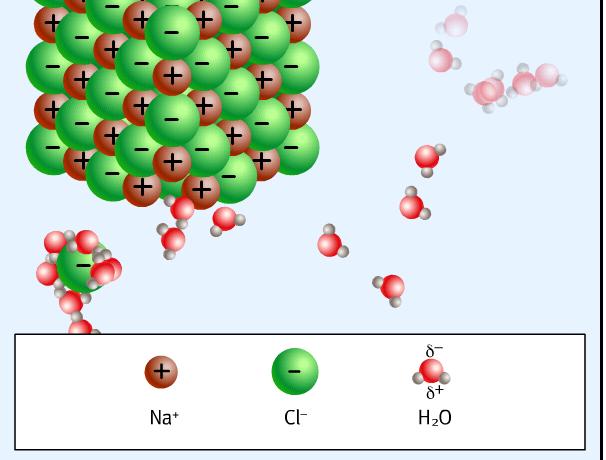 An electrolyte is a substance that produces ions in solution. For example, when sodium chloride is dissolved in water the ionic lattice of Na+ and Cl- ions breaks up to form separate Na+ and Cl- ions which are surrounded by water molecules. This can be represented as follows.
NaCl (s) → Na+(aq) + Cl-(aq)
This process is known as dissociation. The ions in the ionic solid have been separated in the solution process.
Download Free Formation of Solution
Properties Of Gasses Animation
 In gases the particles are widely spaced and move virtually independently of one another. Because of this a gas will become dispersed throughout any container into which it is placed. Also diffusion can occur rapidly. Gases are very compressible because the particles are relatively widely spaced compared with the size of the particles.
To download Properties of Gasses click here
Rutherford Experiment Animation
 The Geiger-Marsden experiment (also called the Gold foil experiment or the Rutherford experiment) was an experiment done by Hans Geiger and Ernest Marsden in 1909, under the direction of Ernest Rutherford at the Physical Laboratories of the University of Manchester which led to the downfall of the plum pudding model of the atom. They measured the deflection of alpha particles (helium ions with a positive charge) directed normally onto a sheet of very thin gold foil. Under the prevailing plum pudding model, the alpha particles should all have been deflected by, at most, a few degrees. However they observed that a very small percentage of particles were deflected through angles much larger than 90 degrees; some were even scattered back toward the source. From this observation Rutherford concluded that the atom contained a very physically-small (as compared with the size of the atom) positive charge, which could repel the alpha particles if they came close enough, subsequently developed into the Bohr model.
To download Rutherford Animation Click here
Source: Learnestv.com
Le Chatelier’s Principle Animation
 The effect of various changes on equilibrium systems can be predicted using the principle developed by the French chemist Henri Le Chatekier. Le Chatelier’s principle can be stated as follows.
To download this Le Chatelier’s Principle Animation click here
Animation source from Learnestv.com
Development of Atomic Theory
- Development of Atomic Theory
- Democritus (440 B.C)
Atom – came from the word "atomos" which means small, indivisible particles
- Antoine Lavoisier (1774)
Law of Conservation of Mass – mass can neither be created nor destroyed in chemical reactions
Example :
3.25 g + 3.32 g = 6.57 g
Hg(NO3)2(aq) + 2KI(aq)
à HgI2(s) + 2KNO3(aq)
4.55 g + 2.02 g = 6.57 g
- Joseph Proust (1799)
Law of Constant Composition – Different samples of a pure chemical substance always contain the same proportion of elements by mass.
By mass, water is: 88.8 % oxygen
11,2 % hydrogen
- John Dalton (1808)
Dalton's Atomic Theory
- All matter consists of tiny particles called atoms.
- An atom cannot be created, divided, destroyed, or converted to any other type of atom.
- Atoms of a particular element have identical properties
- Atoms of different elements have different properties
- Atoms of different elements combine in simple whole-number ratios to produce compounds.
- Chemical change involves joining, separating, or rearranging
Law of Multiple Proportions - Elements can combine in different ways to form different substances, whose mass ratios are small whole-number multiples of each other.
To download complete the development of atomic structure please click here!!!
Chemical Equation
2H2 + O2 -> 2H2O
The formula for the reactants are written to the left arrow, and the formulas for the products are written to the right.
The arrow is read as “gives”, “produces”, “yields”, or “ forms”.
A plus sign on the left side of an equation means ‘reacts with’.
Coefficient of reaction is the ratio between a substances involved in the reaction.
Look at this reaction :
2H2 + 1 O2 -> 2H2O
For example above, coefficient reaction shows that 2 molecules of Hydrogen react with one molecule of oxygen to form 2 molecules of water.
Since matter cannot be created or destroyed in a chemical reaction, a chemical equation must have the same number of atoms in the products as there are in the reactants.
From the example above, we can look that the number of hydrogen atom in the left side is same as the right one, is 4. Either, the number of oxygen atom in the left side is same as the right one, is 2. This equation is called balanced equation
For balancing the chemical equation, can’t determine by change index number.
Index number determines the formula of substances, so that if we change index number as like as we change the kind of substances.
Coefficient number related with a number of substances, so if we change coefficient number that we only change the number of substances.
2H2 + O2 -> 2H2O
This reaction can’t be balanced by change index O in H2O become 2, so the reaction :
2H2 + O2 -> H2O2
There are 3 steps to write a balanced equation, they are:
• Write the word equation consist of name and the form of reactants and products.
• Write the formula equation consists of a chemical formula of reactants and products complete with the phase.
• Balancing, gives a correct coefficient so that it has the same number of atoms in the products and reactants.
Example :
a. Aluminum reacts with sulfuric acid solution to form aluminum sulfate solution and hydrogen gases. Balanced the reaction!
Answer :
Step 1 : write the word equation
aluminum + sulphuric acid solution à aluminum sulphate solution + hydrogen gases
Step 2 : write the formula equation
Al(s) + H2SO4(aq) ->à Al2(SO4)3(aq)+ H2(g)
Step 3 : balancing
2Al(s) + 3H2SO4(aq) -> Al2(SO4)3(aq)+ 3H2(g) Balance
Balancing the chemical equation
1 Determine one of substances (a substances which has a complex chemical formula). Give assign 1 in it. And the other, you can give assign with other characters.
2 Balance a substances related with a substances which given assign 1 first.
3 Balance the other substances. It will easier if oxygen atom is balanced first.
Example :
b. The reaction of aluminum and hydrochloric acid solution to form aluminum chloride solution and hydrogen gases
Al(s) + HCl(aq) -> AlCl3(aq)+ H2(g) not balanced
Step 1 : determine coefficient of AlCl3 = 1, and letter for the other
aAl(s) + bHCl(aq) -> 1AlCl3(aq)+ cH2(g)
Step 2 : balance aluminum and chlorine atom
The number of Al atom in the left side = a, while in the right side = 1, so a = 1
The number of Cl atom in the left side = b, while in the right side = 3, so b = 3
1Al(s) + 3HCl(aq) ->à 1AlCl3(aq)+ cH2(g)
Step 3 : balance Hydrogen atom
The number of hydrogen atom in the left side =3
In the right side = 2c, so c = 1,5
1Al(s) + 3HCl(aq) -> 1AlCl3(aq)+ 1,5H2(g)
Final balance equation : 2Al(s) + 6HCl(aq) -> 2AlCl3(aq)+ 3H2(g)
Doubled Multiple Law (Dalton’s Law)
Compound I contain 50 % sulfur, so the mass of oxygen is 50 %
Compound II contain 40 % sulfur, so the mass of oxygen is 60 %
Differing mass between S : O in compound I = 50 : 50 = 1 : 1
Differing mass between S : O in compound II = 40 : 60 = 1 : 1,5
Differing mass between S : O in compound II = 40 : 60 = 1 : 1,5
The compound appropriate with Dalton’s Law
Halloween Reaction or Old Nassau Reaction
Orange and Black Clock Reaction
By Anne Marie Helmenstine, Ph.D., About.com
The Old Nassau or Halloween reaction is a clock reaction in which the color of a chemical solution changes from orange to black. Here's how you can do this reaction as a chemistry demonstration and a look at the chemical reactions that are involved.
Halloween Reaction Materials
* water
* soluble starch
* sodium metabisulphite (Na2S2O5)
* mercury(II) chloride
* potassium iodate (KIO3)
Prepare the Solutions
* Solution A: Mix 4 g soluble starch in a couple milliliters of water. Stir the starch paste into 500 ml boiling water. Allow the mixture to cool to room temperature. Add 13.7 g of sodium metabisulphite. Add water to make 1 liter of solution.
* Solution B: Dissolve 3 g mercury(II) chloride in water. Add water to make 1 liter of solution.
* Solution C: Dissolve 15 g potassium iodate in water. Add water to make 1 liter of solution.
Perform the Demonstration
1. Mix 50 ml solution A with 50 ml of solution B.
2. Pour this mixture into 50 ml of solution C.
The color of the mixture will change to an opaque orange color after a few seconds as the mercury iodide precipitates. After another few seconds the mixture will turn blue-black as the starch-iodine complex forms.
If you dilute the solutions by a factor of two then it takes longer for the color changes to occur. If you use a smaller volume of solution B the reaction will proceed more rapidly.
Chemical Reactions
1. Sodium metabisulfite and water react to form sodium hydrogen sulfite:
Na2S2O5 + H2O --> 2 NaHSO3
2. Iodate(V) ions are reduced to iodide ions by the hydrogen sulfite ions:
IO3- + 3 HSO3- --> I- + 3 SO42- + 3 H+
3. When the concentration of iodide ions becomes sufficent for the solubility product of the HgI2 to exceed 4.5 x 10⁻²⁹ mol3 dm-9, then orange mercury(II) iodide precipitates until the Hg2+ ions are consumed (assuming an excess of I- ions):
Hg2+ + 2 I- --> HgI2 (orange or yellow)
4. If I- and IO3- ions remain, then an iodide-iodate reaction takes place:
IO3- + 5 I- + 6 H+ --> 3 I2 + 3 H2O
5. The resulting statch-iodine complex is black to blue-black:
I2 + starch --> a blue/black complex
Absorb Chemistry
Absorb Chemistry is divided into units, so you can follow the course all the way through, or use the units individually. Each unit provides a compelling narrative supported by interactive animations, our unique simulations, videos of key experiments, and exercises to ensure concepts have been understood.
Try the free sample units in your class. Also try downloading SCORM-compliant sample units for use in your VLE or learning management system.
Absorb Chemistry Resources
If you are disappointed with the quality of free resources that can be downloaded from the internet, then maybe Absorb Chemistry Resources with over 300 high quality resources (videos, graphics and animations) is what you need. Perfect for creating your own whiteboard presentations.
Absorb Chemistry Resources is a lower cost alternative to Absorb Chemistry that allows you to view or download the resources but not to view or download units from Absorb Chemistry.
Use downloaded resources:
* in PowerPoint presentations;
* with whiteboard authoring software provided by companies such as Promethean or Smart;
* in VLEs or Learning Management Systems;
* offline, in a classroom without an internet connection.
Free Resources
You can view the resources from Absorb Chemistry online free of charge. Over 250,000 users have benefited from this service already, testament to the quality of Absorb. Click here to search for free resources.
Why are they free?
Because we're sure that once you've used them online you'll want to buy Absorb Chemistry Resources, so that you can download them and make your own presentations!
Transmutation of elements
In modern times it has been found that a transmutation from one element to another actually does occur in the process of natural radioactivity. Transmutation of elements can be achieved artificially by the bombardment of elements with high-speed particles by means of such machines as the cyclotron (see particle accelerator). Both artificial and natural transmutations involve changing the number of protons in the atomic nucleus. The transuranium elements are created in this manner. When a nucleus is bombarded with neutrons from an atomic pile or nuclear reactor, some of the neutrons will be absorbed, resulting in an unstable nucleus. The nucleus then becomes more stable by converting one of its neutrons into a proton by beta decay, becoming a nucleus of the next heavier element in the process.
Dalton's Atomic Theory
 It was in the early 1800s that John Dalton, an observer of weather and discoverer of color blindness among other things, came up with his atomic theory. Let's set the stage for Dalton's work. Less than twenty years earlier, in the 1780's, Lavoisier ushered in a new chemical era by making careful quantitative measurements which allowed the compositions of compounds to be determined with accuracy. By 1799 enough data had been accumulated for Proust to establish the Law of Constant Composition ( also called the Law of Definite Proportions). In 1803 Dalton noted that oxygen and carbon combined to make two compounds. Of course, each had its own particular weight ratio of oxygen to carbon (1.33:1 and 2.66:1), but also, for the same amount of carbon, one had exactly twice as much oxygen as the other. This led him to propose the Law of Simple Multiple Proportions, which was later verified by the Swedish chemist Berzelius. In an attempt to explain how and why elements would combine with one another in fixed ratios and sometimes also in multiples of those ratios, Dalton formulated his atomic theory.
The idea of atoms had been proposed much earlier. The ancient Greek philosophers had talked about atoms, but Dalton's theory was different in that it had the weight of careful chemical measurements behind it. It wasn't just a philosophical statement that there are atoms because there must be atoms. His atomic theory, stated that elements consisted of tiny particles called atoms. He said that the reason an element is pure is because all atoms of an element were identical and that in particular they had the same mass. He also said that the reason elements differed from one another was that atoms of each element were different from one another; in particular, they had different masses. He also said that compounds consisted of atoms of different elements combined together. Compounds are pure substances (remember they cannot be separated into elements by phase changes) because the atoms of different elements are bonded to one another somehow, perhaps by hooks, and are not easily separated from one another. Compounds have constant composition because they contain a fixed ratio of atoms and each atom has its own characteristic weight, thus fixing the weight ratio of one element to the other. In addition he said that chemical reactions involved the rearrangement of combinations of those atoms.
So that, briefly, is Dalton's theory. With modifications, it has stood up pretty well to the criteria that we talked about earlier. It did not convince everyone right away however. Although a number of chemists were quickly convinced of the truth of the theory, it took about a half century for the opposition to die down, or perhaps I should say die off.
Let me point out again the difference between a model of atoms and a theory of atoms. A model focuses on describing what the atoms are like, whereas the theory not only talks about what the atoms are like but how they interact with one another and so forth. Dalton's model was that the atoms were tiny, indivisible, indestructible particles and that each one had a certain mass, size, and chemical behavior that was determined by what kind of element they were. We will use that model of an atom for now, but we will modify it considerably in a later lesson.